All of the pictures on this website were taken on our tours by Captain Simon
Marine Wildlife
The Pacific waters off southern Vancouver Island are teeming with an abundance of marine wildlife. There is a wide variety of fish and bird species, and of course large marine mammals. Included here are just a few examples of what lives in the southern Vancouver Islandwaterways, specifically the marine wildlife you are most likely to witness on our Whale Watching tour.
Orca Whales
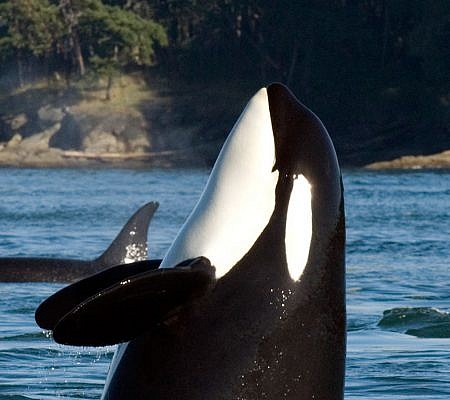
The striking black and white orca whale is found throughout the entire world inhabiting every ocean on the planet. These sophisticated mammals, which are in fact part of the dolphin family, are one of the few species of whales that migrate from hemisphere to hemisphere, though their largest populations tend to be more abundant in cooler waters.
Orca whales are cetaceans, a large group of approximately 80 kinds of whales, dolphins, and porpoises. The largest member of the dolphin family (females can grow as large as 23 feet in length, while males can reach 32 feet), orca whales have highly developed brains, and like all dolphins, use sophisticated biological sonar called echolocation, to communicate with one another. When the Northern Resident Community whales arrive in Johnstone Strait on the northeast shores of Vancouver Island, they “announce” their arrival to other whales already in the area with their highly developed vocal activity.
- Class: Mammalia
- Order: Cetacea
- Suborder: Odontoceti
- Family: Delphinidae
- Genus: Orcinus
- Species: Orca
Types of Orcas
Orca whales are divided into three seperate categories based upon geographical location and behaviour. It is speculated that these three distinct groups of orcas in the Pacific Northwest may be the result of food preference and availability. Resident Orcas tend to have distinct and stable migration patterns and family structures, while Transient Orca Whales are more loosely organized. It is estimated that there are approximately 170 Transient Orca Whales living along the western North American seaboard from Mexico to the Bering Sea. Little is currently known about the third category, Offshore Orcas, although they are being actively studied by scientists. Discovered in 1991, the Offshore Orcas are most commonly seen 15 to 25 miles out at sea off Vancouver Island and the Queen Charlotte Islands. It is possible that this third category of whales is the ancestral population of the Northern and or the Southern Resident orca whales.
Social Structure
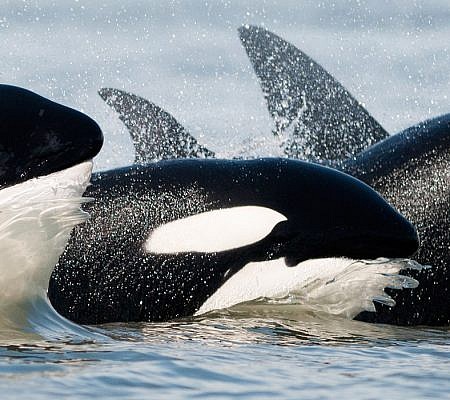
Orca whales generally live in groups known as pods, which are comprised of two or more females, calves, one or more males, and juveniles. These stable, matrilineal pods of orcas often consist of a mother, her offspring, and several generations of family members who travel together. Some offspring stay with their mother for life. This type of familial structured pod has been consistently observed in the Pacific Northwest. While all pods share common sounds, each pod also has its own distinctive sound.
Foraging
With 46 to 50 conical shaped teeth that point slightly inwards and backwards, the orca is well adapted for hunting. While resident orca whales tend to feed on fish species such as herring or salmon, transient whales eat a variety of animals including smaller whales, penguins, porpoises, harbour seals, sea lions, squid and sharks. Orcas generally forage individually, although it is thought by scientists that a coordinated method of group hunting probably occurs.
Breeding
Although very little is understood about the orca’s breeding habits, newborn calves have been observed throughout the year, indicating no particular breeding season. Orcas are considered to be sexually mature between the ages of 10 and 18 years of age, with females believed to be reproductively active into their 40’s. The gestation period for an orca is approximately between 13 to 17 months, and a newborn calf is generally about 6-7 feet long, and weighs approximately 400 pounds.
Resting
When resting, orca whales generally maintain a slow swimming speed (2 knots or less), and synchronize their breathing with other whales within their social group. They also rest while laying almost motionless on the surface of the water. During these very quiet rest periods, orcas emit just a few discrete sounds, and scientists believe that one group member may remain more attentive than the remaining pod.
The Southern Resident Orca Whales
The southeast shores of Vancouver Island are home to at least 83 orca whales who migrate here every spring. The southern resident orca whales spend six to seven months a year in the protected waters of Haro Strait, the Strait of Juan de Fuca, and the Georgia Strait near theFraser River.
These whales constitute a large extended family comprised of three distinct pods: J, K, and L. Subpods are formed within each of these three pods, all of which center around older females such as grandmothers or great-grandmothers. Male and female offspring remain close to their mothers for life.
As with all orcas worldwide, the southern resident orcas whales communicate with one another using echolocation, a unique form of biological sonar ‘calls’ that can travel ten or more miles under the ocean.
As of September 2004, J pod contained 22 whales, and was considered the pod most likely to appear all year round in the lower Puget Soundarea near the San Juan Islands. This pod seems to prefer the west side of San Juan Island during mid to late spring. The eldest member of J pod is estimated to be approximately 83 years old, and there is only one mature male, being approximately 52 years old. Among the remaining members, there are thirteen juvenile orcas.
K pod, the smallest of all three pods, has 20 members, with the matriarch being approximately 82 years old. This pod contains one sprouter male and nine juvenile whales.
L pod, the largest pod of the southern resident orcas contains 41 whales and has two mature males, sixteen juvenile whales, and five sprouter males.
Gray Whales
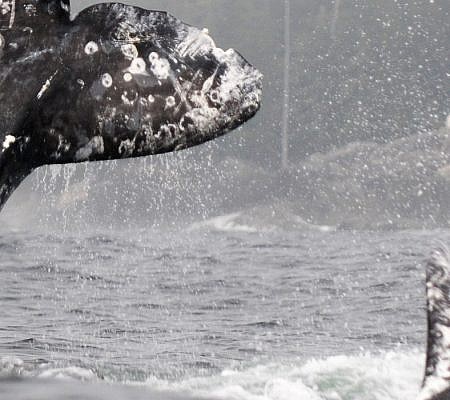
Inhabiting both the Eastern and Western shores of the Pacific Ocean, the Gray Whale is the first "friendly whale" to approach and rub on boats, and at times allow passengers to pet them. This impressive marine mammal has long been the subject of human interest, most notably being the first whale, along with the Right Whale, to be aggressively hunted during the first half of the 20th Century. Following decades of extensive whaling, the Gray Whale herds that inhabit both the Eastern (North American) Pacific shores and the Western (Asian) Pacific waters have been declared extinct at least once in the past 100 years. These two remaining Grey Whale herds (there were at one time, four global herds) have persevered despite great odds against their survival.
The Western Pacific Gray Whale Herd population has suffered immensely due to massive whaling during the early 20th Century by Japan, theU.S., Norway, and the Soviet Union. By the mid 1950's, scientists were convinced that this herd had become extinct, however by the 1960's and 1970's there were a few sightings of this herd. During the 1990's about 200 Asian Pacific Gray Whales were observed in the Russian Sakilin Islands, reviving hope for the survival of this battled herd.
The Eastern Pacific (North American) Whale Herd population resides along the western shores of North America from it's winter calving lagoons of Baja Mexico all the way up to the Bering Strait and the Arctic Seas. A robust and healthy herd, the Eastern Pacific Gray Whale population is indeed one of the most observed, studied, and loved whale populations on earth. One of this whale's most predominant features is it's annual breeding and feeding migratory pattern, which sees upwards of 20,000 Gray Whales congregate in the shallow lagoons of Baja California (Mexico) to breed, followed by a massive northern migration along the North American Pacific shoreline in the spring. This fantastic wildlife spectacle, which boasts a 20,000 km (12,500 mile) round-trip, is considered by some scientists to be the longest migration of any mammal on earth.
Grey Whale Facts
- Scientific Name: Eschrichtius Robustus
- Common Name: Gray Whale
- Length of Female: 12.6 -14.1 metres (41-46 feet)
- Length of Male: 11.7 - 13.2 metres (38-43 feet)
- Weight: A 13.4 metre (43.8 foot) Female: 34.6 tonnes, excluding fluids and blood.
- Swimming Speed: 4-6 knots
- Longevity: 50 years
- Gestation Period: 12-13 months
- Size of Newborn Calf: 4-5 metres (13-16 feet)
- Distribution: North American Coast; Mexico to Bering, Arctic Seas. Asian Coast; Sea of Okhotsk to Japan, Korea. Atlantic Coast; Extinct
- Social Structure: Live in herd-like structures, similar to land mammals. Longest social bond is between mother and calf. Scientists suspect a highly complex social relationship exists.
- Communication: Gray Whales communicate through a variety of low frequency sounds such as grunts, rumbles, moans, croaks, and loud clicks and bangs. The function of these sounds is relatively unknown.
- Foraging: Feeds on buried organisms and those just above bottom sediments. Also: Planktonic Prey on kelp beds, in surf zones, shorelines, and shallow offshore banks. Gray Whales are a "Baleen" Whale; they do not have teeth, but rather have a filtering apparatus in their mouths.
Minke Whales
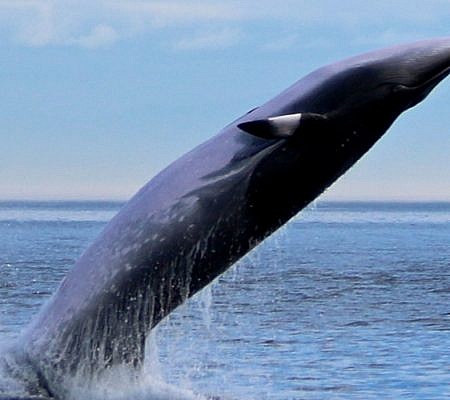
Found in all oceans in the world, the Minke Whale, the second smallest of the baleen whales, is one of the most abundant whales and also a principal target of today's whaling industry.
Inhabiting both temperate and polar waters in the Northern and Southern hemispheres, the Minke Whale population is estimated to be over 761,000 in the Antarctic, 149,000 in North Atlantic waters, and about 25,000 in the Northwest Pacific ocean.
The Minke whale feeds primarily on fish, and krill. In the northern Pacific ocean, "Pacific Saury" accounts for 80% of this whale's diet. Three species of euphausiids (a shrimp-like crustacean) and one species of copepod are also part of the Minke Whale diet.
Unlike other whales (Greys, Orca's), the Minke Whale is not known to coordinate feeding and travelling patterns with other Minke's. Rather, the Minke Whale seems to conduct itself independently of other Minke's, leaving scientists to wonder how mating is conducted.
Minke Whales do not seem to produce intense or low frequency sounds as do other larger finner whales. It is suspected by researchers that the Minke Whale does not have the capacity to communicate over great distances with one another.
While the Minke Whale population remains relatively high in the Pacific Northeast, they are not as observed as other whales such as Orca's, Humpback's, and Gray Whales. Minke's will often swim to the surface of the water for 3-5 blows, then descend for a 3-7 minute dive. InIceland and Scotland, however, the Minke Whale is the "main event" for whale watching companies, as they are much more predictable there.
During the 1970's Minke Whales were hunted for everything from cosmetics to mink food, and for human consumption. They are currently hunted in the North Atlantic, the Northwest Pacific Ocean, and the Antarctic primarily for human consumption.
Minke Whale Facts
*Note: The following information applies only to the Northern Hemisphere Minke Whale. Southern Hemisphere Minke Whales are quite similar.
- Scientific Name: Balaenoptera Acutorostrata
- Common Name: Minke Whale
- Maximum Adult Length: Female: 9.1 metres (30 feet), Male: 8.8 metres (29 feet)
- Longevity: Up to about 60 years
- Gestation Period: 10 Months
Humpback Whales
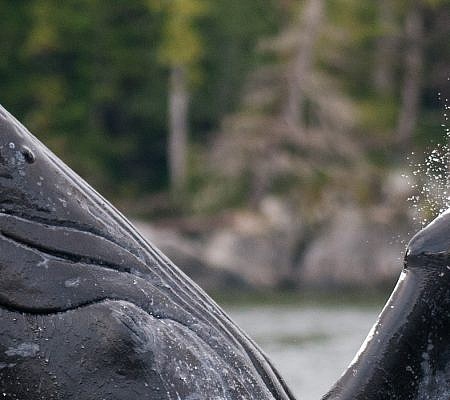
Known to be one of the most playful whales on earth, the Humpback Whale inhabits every ocean on the planet, and is most famous for it's capability of song. During mating season, the males will sing organized and complex songs with distinct melodies and themes that can be heard over twenty miles away. These song patterns change yearly, and every few years a new song will emerge.
Of all cetaceans, the Humpback Whale seems to be the most athletic, impressing observers with much breeching, spy hopping and other such playful behaviour. In the arctic they have been seen turning over small icebergs for fun.
Scientists believe there are about 30,000-40,000 Humpback Whales in the world at present, or about 30-35% of the original population. Humpbacks are slow swimmers, making them particularly vulnerable to extensive whaling campaigns in the early 20th century. It is believed that over 100,000 Humpback Whales were killed before they were listed as endangered in 1966.
While Humpback Whales are generally not as social as other whales, they do cooperatively feed, migrate, and breed. Residing within a loose-knit social structure, Humpback Whales live individually alone, or within transient small groups that come together periodically. During the summer months they tend to stay in such groups for longer periods of time to forage and feed co-operatively.
The Humpback Whale eats approximately one and a half tonnes per day of small fish such as herring, as well as krill. During feeding periods, Humpback Whales cooperate with one another in a system known as "bubble netting", in which over 20 whales will surround a school of fish or krill, and create a 'net' of bubbles which forces small fish to gather in the center. With their mouths open wide, a few Humpbacks will lunge up the middle of this net and shovel the gathered fish in while breaking the surface with their catch.
Humpback Whales living in the Pacific Ocean will travel from their summer feeding grounds in Alaska to the Hawaiian Islands, some 4200 kilometers away. Swimming up
to 150 km per day during these migrations, they will travel either individually or with
one to three other Humpbacks.
Humpback Whale Facts
- Scientific Name: Megaptera Novaeangliae
- Common Name: Humpback Whale
- Length: Female: 13.7 - 15.2 metres (45 - 50 feet)
12.2 - 14.6 metres (40 - 48 feet) - Gestation Period: 12 Months
- Longevity: 45-50 Years
Dall's Porpoises
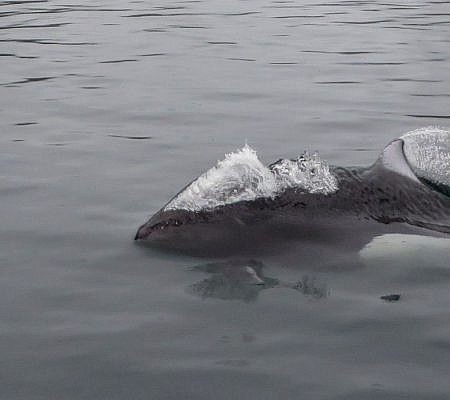
Inhabiting the North Pacific Ocean from Japan to the west coast of North America, the Dall's Porpoise is the fast swimming cetacean, often exceeding speeds of 45 miles per hour. Often mistaken for a small Orca Whale, this porpoise has a stocky, black body with large white sections on the flanks and belly. Commonly seen in Hecate Strait, Queen Charlotte Strait, Juan de Fuca Strait, and Haro Strait in British Columbia, the Dall's Porpoise feeds on a wide variety of fish, squid and crustaceans. While Dall's Porpoises are not considered endangered, exact population estimates are unknown.
A friendly and curious porpoise, the Dall's Porpoise is known to surface close to boats and playfully bow ride at high speeds.
Dall's Porpoise Facts
- Scientific Name: Phocoenidae Dalli
- Common Name: Dall's Porpoise
- Length: 2.1 Metres (7 Feet)
- Gestation Period: 12 Months
- Longevity: 16-17 Years
Stellar Sea Lions
Inhabiting the northern Pacific waters between Japan and North America, most Stellar Sea Lions are found along the west coast of British Columbia and Alaska. Considered to be non-migratory, scientists have not observed mass movement to summer or winter grounds, although individuals or small groups of Stellar Sea Lions have been seen travelling hundreds of miles in search of food.
The largest of the eared seal family, the female Stellar Sea Lion is estimated to weigh approximately 600 - 700 pounds, while the male weighs about 1,500 pounds.
The Stellar Sea Lion population is estimated to be almost 80,000. Feeding on fish, Stellar Sea Lions are carnivorous, their jaws containing sharp teeth similar to those found in cats, dogs, and other flesh eating animals.
Their only natural enemy is the Orca Whale, which Sea Lions can often escape by scrambling onto rocky ledges avoiding capture.
Steller Sea Lion Facts
- Scientific Name: Eumetopias Jubatus
- Common Name: Stellar Sea Lion
- Length: 8 - 9 Feet
- Gestation Period: 9 Months
- Longevity: 20 Years
Bald Eagles
Weighing from 7 to 15 pounds and having a wing span of 6 - 8 feet, the Bald Eagle is one of the largest birds in North America, with the female being larger than the male.
Found over most of North America from Alaska and Canada to northern Mexico, approximately 20,000 bald eagles live in British Columbia, and over 70,000 live in Alaska, roughly half of the world's Bald Eagle population. Indeed, the high salmon stocks in this region account for the Bald Eagle's prominent presence.
Reaching speeds of about 35 mph, flying to an altitude of 10,000 feet, and possessing a lifting power of about 4 pounds, the Bald Eagle is indeed a strong bird with a hunting area varying between 1,700 to 10,000 acres. Once paired, bald eagles will remain together until one dies.
Bald Eagle Facts
- Scientific Name: Haliaeetus Leucocephalus
- Common Name: Bald Eagle
- Length: 29 - 42 Inches
- Longevity: 40 Years